


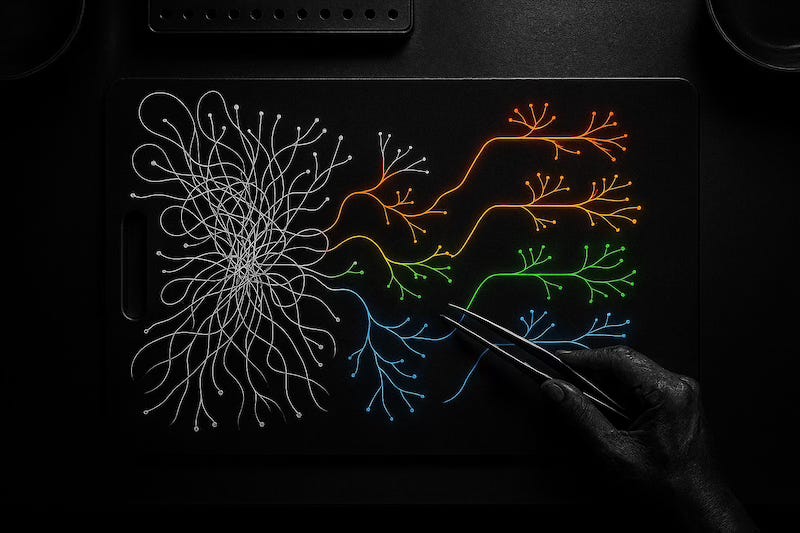
Forget the old-school mentality that says “you can’t teach an old dog new tricks.” That’s a myth. Neuroscience proves your brain is dough, not concrete—it can be reshaped with deliberate effort.
Think about the first time you stepped onto a busy line. Your knife skills were clumsy, your timing was off, and every ticket felt like a crisis. At least that was my experience.
But you didn’t just accept that you were “bad at it.”
You showed up day after day and did the reps. You practiced your brunoise until it was perfect. You learned the rhythm of your station until it was second nature, building the mental muscle to stay cool under fire. Mental resilience isn’t something you’re born with; it’s a skill you train, just like mastering a new station.
It’s not just about getting better. It’s a matter of mastering the art of dealing with the relentless chaos that’s gutting the hospitality industry’s workforce. Imagine managing the kind of burnout where your energy feels like it’s evaporating in a steaming kitchen. Or the anxiety that gnaws at you like a persistent kitchen timer going off. Think about overcoming addiction, where the craving is as constant as the sizzle on a busy grill, and battling chronic fatigue, which hangs over you like the smoke from an overworked exhaust. These high-stakes challenges are like a six-alarm fire that you’re up against every day.
This isn’t just a kitchen analogy; it’s a fundamental principle of how your brain actually works, and the science behind it has a name.
The Science: Understanding Neuroplasticity
To change, you must understand the fundamental science that makes it possible. This isn’t just theory; it’s the biological underpinnings that you are built to adapt and overcome.
Imagine stepping into a bustling kitchen for the first time, the air thick with the aroma of spices and the clatter of pans. You fumble with your knife, feeling clumsy and out of place. But as weeks turn into months, something begins to change. The once daunting tasks become second nature, refined through persistent effort and practice.
This transformation is not just a result of muscle memory; it’s the power of your brain’s ability to adapt.
The scientific term for this process is neuroplasticity, the brain’s capacity to reorganize itself by forming new neural connections. Once thought to happen only in childhood, we now know it is a lifelong process.
This is the science that proves you are not “just wired this way.” As neuroscientist Parvaneh Gazerani’s (2025) research shows, your brain is not “fixed” or “broken”; it is built to adapt. With the right training, you can guide that adaptation. This understanding is built on the foundational work of key researchers to whom I consistently return.
Meet the Experts Whose Research Shaped the S.H.A.R.P. Mind Protocol
While the S.H.A.R.P. Mind Protocol is informed by the broader field of contemplative neuroscience, it resonates specifically well with the research of Dr. Lisa Feldman Barrett, Dr. Amishi Jha, Dr. Daniel Siegel, and Dr. Tania Singer. Their collective work decodes the mechanisms of neuroplasticity and provides the foundational scientific recipe for intentionally re-wiring your mind.
Dr. Lisa Feldman Barrett: Her theory of “Constructed Emotion” shows that emotions aren’t hardwired reactions. Instead, your brain constructs them on the fly, much like a chef assembles a dish from available ingredients: past experiences, body sensations, and the concepts you’ve learned. By changing the “ingredients”—like expanding your emotional vocabulary or better managing your body’s energy budget—you can change the final emotional dish your brain serves up (Barrett, 2018).
Dr. Amishi Jha: Her research on the “attention system” is critical for high-pressure work. Think of your attention as a single flashlight in a dark walk-in cooler whose bulb has gone out. Under stress, that beam flickers and focuses on threats instead of the task at hand, leading to costly mistakes and “in the weeds” paralysis. Dr. Jha’s “industrial-strength” training with the U.S. Military shows that with specific drills, you can learn to hold that beam steady, cutting through the noise when the pressure is on (Jha, 2021).
Dr. Daniel Siegel provides the “how-to” for the rewiring process through his concept of SNAGing the brain: Stimulating Neuronal Activation and Growth. Every time you intentionally complete a drill, like the ones in the S.H.A.R.P. Mind Protocol, you aren’t just thinking differently—you are physically building a new, stronger brain (Siegel, 2011).
Dr. Tania Singer: Her research draws a crucial line between empathy and compassion. Empathy, or feeling another person’s pain, activates pain networks in your own brain, turning you into a “Pain Sponge” that quickly leads to burnout. This empathy burnout is a primary driver of the industry’s record turnover rates, which range from 30% to 300%. Compassion, however, is a trainable skill that activates the brain’s reward and care systems. It allows you to become an “Action Machine”—supporting your team and solving problems without draining your own battery (Max-Planck-Gesellschaft, n.d.; Singer & Bolz, 2013; Klimecki & Singer, 2011)
Their combined research forms a practical toolkit:
S - Steady your Focus: daily mindfulness drills strengthen attention and resilience under stress (Jha);
H - Hold Thoughts Lightly: recognize that thoughts and emotions are brain predictions, not absolute truths, making it easier to question and reshape them (Barrett);
A - Assess Your Body: use interoception to notice and regulate internal states, supporting well-being and emotional intelligence (Siegel);
R - Recognize Patterns: understand that emotion and attention patterns are shaped by social and bodily context (Barrett, Jha, Siegel, Singer);
P - Project Kindness: train compassion, rather than empathy alone, to build resilience and foster prosocial behavior (Singer).
As you can see, the science provides the recipe, but S.H.A.R.P. is the protocol that puts it on the line, turning these powerful ideas into daily drills.
The Shift: From Science to S.H.A.R.P. Protocol
Science is the ‘What,’ S.H.A.R.P. is the ‘How’
The S.H.A.R.P. Mind Protocol is built on this scientific foundation. Specifically, Module 02: Laying the Groundwork: Rewire Your Default Settings provides the core knowledge you need to understand this entire process.
But just like knowing the metallurgy of a blade doesn’t make you a chef, knowing the science of neuroplasticity isn’t enough to change your mind. You cannot simply think your way into a new way of being. Neuroplasticity requires consistent, challenging practice. You have to do the reps. Willpower alone is not enough.
The S.H.A.R.P. Mind Protocol is the manual, the prep list, for this rewiring process. It translates scientific principles into specific, tactical drills you can practice for just 12 minutes a day to build a more focused, resilient, and effective mind. Ask yourself: “What will I lose if I don’t commit 12 minutes today to training my mind?” This one question could make all the difference in creating a habit that benefits you in the long term. Choose a consistent time each day and mark it on your calendar to begin planting the seeds for lasting change.
The S.H.A.R.P. Mind Protocol is the manual—the prep list—for this rewiring process. It translates scientific principles into specific, tactical drills you can practice for just 12 minutes a day to build a more focused, resilient, and effective mind. (This sentence duplicates the previous paragraph and may be omitted for flow and conciseness.)
Your Next Step: Discover the S.H.A.R.P. Mind Protocol
Just as no dinner service runs smoothly without a prep list, your mind also needs a plan. The S.H.A.R.P. Mind Protocol acts as your mental prep list—clear, actionable, and designed for high-performance.
Explore how it can help you build a sharper, more resilient mind.
With you in the grind,
Dr. Werner Absenger (”drA”)
Chef | Scientist | Assistant Professor | Founder
References:
Barrett, L. F. (2018). How emotions are made: The secret life of the brain. Mariner Books: Houghton Mifflin Harcourt.
Jha, A. (2021). Peak mind: Find your focus, own your attention, invest 12 minutes a day (First edition). HarperOne, an imprint of HarperCollins Publishers.
Gazerani, P. (2025). The neuroplastic brain: Current breakthroughs and emerging frontiers. Brain Research, 1858, 149643. https://doi.org/10.1016/j.brainres.2025.149643
Klimecki, O. M., & Singer, T. (2011). Empathic distress fatigue rather than compassion fatigue? Integrating findings from empathy research in psychology and social neuroscience. In B. Oakley, A. Knafo, G. Madhavan, & D. S. Wilson (Eds.), Pathological Altruism (pp. 369–383). Oxford University Press. https://doi.org/10.1093/acprof:oso/9780199738571.003.0253
Max-Planck-Gesellschaft. (n.d.). The ReSource Project. https://www.social.mpg.de/34713/sp-resource
Siegel, D. J. (2011). Mindsight: The new science of personal transformation. Bantam Books.
Singer, T., & Bolz, M. (Eds.). (2013). Compassion: Bridging practice and science [E-reader version] (1st ed.).
Image Credit:
Google. (2025). Organizing neural pathways: A culinary metaphor for emotional regulation. [AI-generated image]. Gemini.
Generative AI Tools Acknowledgement: After conducting extensive research for this article in peer-reviewed journals, I partially generated this text using Google Gemini. After generating the draft language, I reviewed, edited, and made significant revisions in Grammarly (2025), and I take ultimate responsibility for the content of this article.